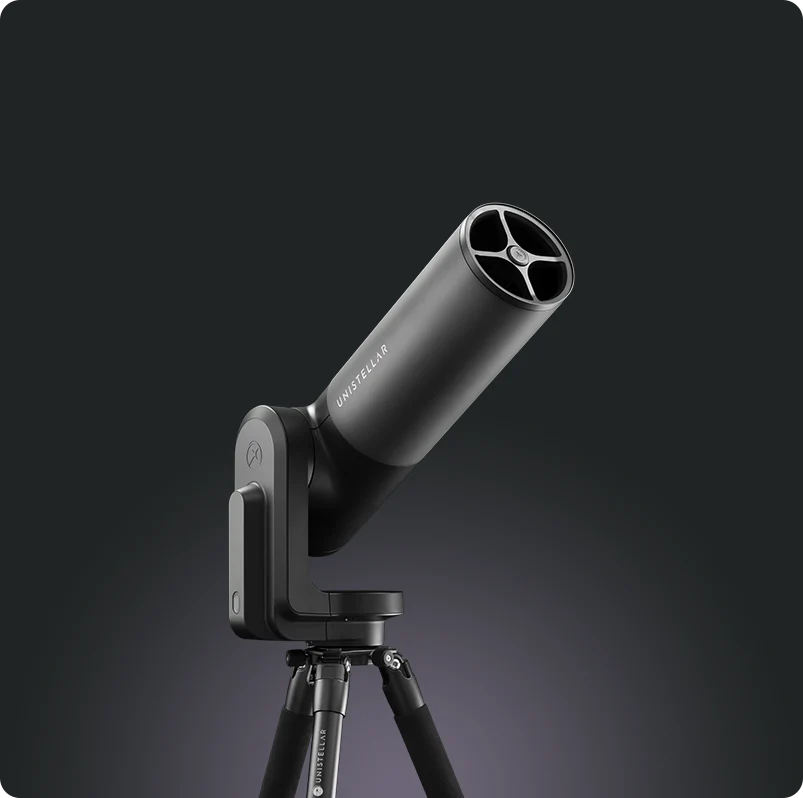
Smart telescopes have transformed stargazing by pairing advanced optics with app control, automated tracking, and AI-powered guidance. The best smart telescope in 2026 eliminates the steep learning curve of traditional astronomy, letting anyone find and photograph galaxies, nebulae, and planets in minutes. This guide ranks the top 10 smart telescopes by image quality, ease of use, portability, and value — comparing every major AI and app-enabled smart telescope available today, from the ZWO Seestar S50 to the Unistellar eQuinox 2.
What Is a Smart Telescope?
A smart telescope is a self-contained astronomical instrument that combines optics with motorized tracking, an onboard computer, and smartphone or tablet control. Unlike a traditional telescope — which requires manual pointing, alignment, and focusing — a smart telescope handles all of this automatically. You simply open an app, tap an object like the Andromeda Galaxy or Saturn, and the telescope slews to the target, locks on, and begins capturing a stacked image in real time.
The category breaks into two distinct groups. Dedicated smart scopes (ZWO Seestar S50, Unistellar eVscope, Vaonis Vespera) are all-in-one units designed purely for automated imaging — no eyepiece required, results delivered to your phone. GoTo computerized telescopes (Celestron NexStar, SkyWatcher AZ-GTi) are traditional optical tubes on motorized mounts that can find thousands of objects automatically but still use conventional eyepieces for visual observing.
Smart Telescopes vs Traditional Telescopes
| Feature |
Smart Telescope |
Traditional Telescope |
| Setup time | 5–10 minutes | 15–45 minutes |
| Learning curve | Very low — app-guided | Moderate to high |
| Astrophotography | Automatic live stacking | Manual setup, separate software |
| Visual observing (eyepiece) | Screen/app only (most models) | Direct eyepiece view |
| Light pollution handling | Built-in LP filters on top models | Manual filter add-ons |
| Price for comparable aperture | Higher | Lower |
| Social / shareable results | Instant phone gallery | Requires extra processing |
Smart telescopes win on convenience and immediacy — a beginner can capture a stunning nebula image on their first night out. Traditional telescopes win on value per aperture and the immersive experience of looking through an eyepiece with your own eye. Many serious astronomers own both types.
New to Telescopes?
Smart scopes are a great entry point. If you want to compare them against traditional options, our best telescope for beginners guide covers the full range of starter choices with hands-on guidance. For setting up a telescope for the first time, our step-by-step guide walks you through the whole process.